
Against the Other Schools
The Book of Five RingsThis thread traces Musashi’s critique of rival traditions and his effort to distinguish strategic substance from fashionable form.
increasing Bearing strength in each event
 decreasing
Bearing strength in each eventdecreasingTechnique for Sale

The Market for Display
Flowers Without Substance
Musashi criticizes teachers and learners who decorate technique and seek to show it off. He compares their emphasis on outward bloom with neglect of the useful core.
A Warning About Profit
A Way can become a livelihood built on reputation rather than truth. The critique establishes a standard against which he judges rival instruction.
Shrine Traditions
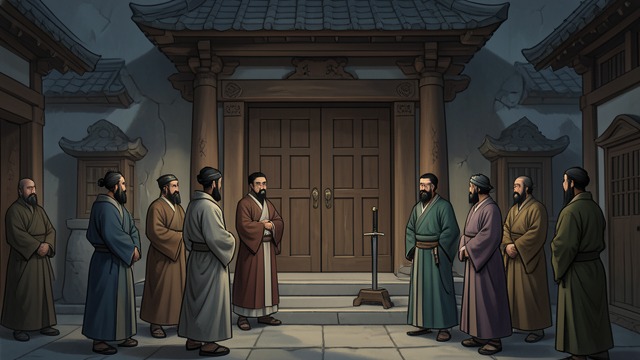
The Rise of Schools
Instruction Across the Country
Musashi notes that attendants of Kashima Shrine and Katori Shrine received instruction associated with divine revelation and formed schools that taught widely.
Recognition and Criticism
He acknowledges the historical force of these traditions but argues that much contemporary strategy has narrowed into sword fencing. The issue is not lineage alone, but what a teaching enables.
The Extra-Long Sword

Length as a Crutch
Dependence on Reach
Musashi challenges schools that rely on extra-long swords to keep opponents distant. He argues that reach cannot replace strategic understanding.
A More Flexible Measure
He does not condemn length in every case, but rejects automatic preference. A practitioner must be able to meet different conditions rather than trust one advantage.
Strength and Dexterity

Power Without Principle
Coarse Force
Musashi disputes the belief that a strong hand or forceful cut guarantees victory. Excessive strength can carry a sword away from its purpose.
Strategic Intelligence
The decisive concern is killing the enemy through sound principle, not demonstrating power. This argument challenges a culture of technique measured by visible effort.
Surface and Interior Rejected

No Secret Gate
Against Artificial Divisions
Musashi rejects the notion that combat has a hidden interior and a separate surface. In practice, understanding develops through experience and instruction suited to the learner.
Direct Teaching
He says he teaches what can be understood and gradually approaches deeper principles. The critique ends by privileging trustworthy training over labels and written pledges.
During the Ground Book’s critique of contemporary instruction
During the account of recent strategy schools
During the Wind Book’s first critique
During the Wind Book’s discussion of strong cutting
Near the end of the Wind Book
